A No-Fail Checklist for Choosing a Rug Size in the Living Room
A rug can finish a living room or quietly spoil it, and the culprit is almost never the pattern. It is the size. Buy one that is too small and the sofa appears to be standing on a bath mat; buy one that is too big and the floor loses its breathing space at the edges. Neither mistake reads clearly in a showroom, which is why the measuring has to happen at home, on your floor, around your furniture. The whole exercise takes about twenty minutes. It will save you a return shipment, a restocking fee, and a year of quiet irritation every time you walk into the room.
Measure the room before you fall in love
Sketch the room on a sheet of paper — no need for scale, just proportion. Write down the wall-to-wall length and width, then mark everything that interrupts the floor: doorways and the arc of their swing, a fireplace hearth, radiators, floor vents, built-in shelving, the step down to a sunroom. These are the fixed points a rug has to respect.
Next, decide how much bare floor you want to see around the edges. A rug that runs to within a few inches of every wall reads as wall-to-wall carpet that shrank in the wash. As a working guide, leave 12 to 18 inches of visible floor along the walls in a medium room, and closer to 24 inches in a large one. In a small room the instinct is to shrink the rug to make the space feel bigger; it does the opposite. A rug that covers most of the floor pushes the walls outward visually.
Measure the furniture group, not just the room
Here is where most people go wrong. A living room rug is not sized to the room — it is sized to the seating arrangement sitting on it. Measure the widest span of the group: from the outer edge of the sofa to the outer edge of the chair opposite or beside it. That number, plus a margin, is your minimum rug width.
The coffee table test
Put the coffee table in the middle of the section. A rug should extend at least 6 to 8 inches past the table on every side, and 12 to 18 inches if the room allows it. That margin is what lets someone pull a chair forward, set down a cup, or put their feet up without landing half on the floor. If the table is large — say 130 cm long — a 160 x 230 cm rug will technically fit under it but will leave almost nothing for the seating. Go bigger.
The seating footprint
Measure the depth of your sofa and chairs from the front of the seat cushion to the back of the frame. That depth tells you how much rug the front legs will need. Chairs that swivel or recline need extra clearance behind them, and recliners need the rug to stop short of the mechanism or clear it entirely.
Pick a leg-placement rule and stick to it
There are only three arrangements worth considering, and each suits a different room. Choose one before you shop so the size follows from the rule rather than the other way around.
- All legs on the rug. Every piece of seating sits fully on the rug, with floor visible beyond it. This is the calmest, most generous look and the right choice for large rooms and open-plan spaces where the seating floats away from the walls. It needs a big rug — often 240 x 340 cm or more.
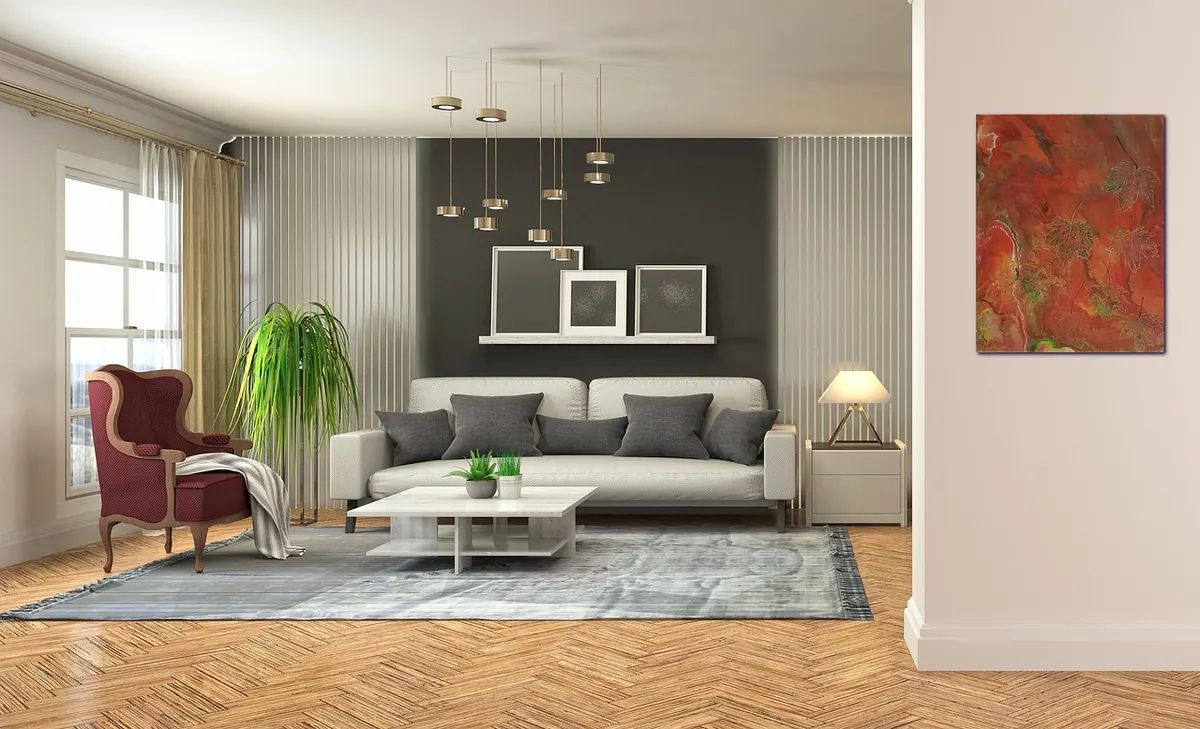
- Front legs on the rug. The sofa's front feet and the chairs' front feet rest on the rug; the back legs stay on bare floor. This is the workhorse arrangement for ordinary living rooms and the one that flatters most spaces. It anchors the group without demanding a huge rug.
- No legs on the rug. The rug floats in the middle, holding the coffee table and nothing else. It only works when the gap between sofa and chairs is narrow, and the rug should reach to within a few inches of the sofa's front legs. A small rug marooned in the center of a big room looks like a mistake, because it is one.
Match the size to the layout
Rugs come in loose nominal sizes, and metric and imperial listings are often sold side by side. A 160 x 230 cm rug is roughly five by eight feet; 200 x 290 cm is close to six and a half by nine and a half; 240 x 340 cm is about eight by eleven. Treat these as starting points, not rules.
- 5 x 8 ft (about 160 x 230 cm): small sitting rooms, a pair of armchairs, or a single sofa with a tight chair pair. Front legs on, at most.
- 8 x 10 ft (about 240 x 300 cm): the standard for a three-seat sofa plus two chairs. Front legs on, or all legs on in a compact room.
- 9 x 12 ft (about 275 x 365 cm): larger rooms, sectionals, and seating groups with a chaise. Comfortably fits the all-legs-on arrangement.
- Runners (roughly 80 x 250 cm): hallways and the strip of floor behind a sofa in an open plan. Not a substitute for a living room rug.
- Round rugs: measure the diameter against the widest part of the seating group. A round rug under a rectangular sofa arrangement wants to be at least as wide as the sofa is long, or it reads as a doily.
Handle awkward rooms on purpose
Not every living room is a neat rectangle. In an open plan, let the rug define the seating zone rather than trying to cover the whole floor — the rug's edges do the work that walls would do in a separate room. Align it with the furniture group, not with the room's walls, or the whole arrangement will feel slightly off without anyone being able to say why.
With a fireplace, keep the rug a comfortable distance in front of the hearth rather than on it, and check that it does not sit under a spot where embers or ash could land; wool and synthetic fibers both respond badly to heat. In a long narrow room, two matching rugs can work better than one enormous one, provided they are the same size and placed symmetrically. And if the room is asymmetrical, center the rug on the seating, not on the room.
Tape it out before you buy
Painter's tape, or a couple of old sheets folded to size, will tell you more than any product photo. Lay out the rectangle on the floor where the rug will go, then leave it there for a day. Walk the paths you actually use — doorway to sofa, sofa to window, chair to bookshelf. Sit down. Look at the shape from the main entrance to the room.
Two things usually surface. First, the tape shows whether the rug is crowding a door swing or swallowing the walkway. Second, it shows how much of the rug will disappear under the sofa. Expect a third of the rug to be hidden; that is normal and it is why the visible border matters so much.
If the tape rectangle looks too small on the floor, the rug will look too small in the room. Trust that reaction — it is much cheaper to size up now than to replace the rug later.
The five-minute final check
Before you order, run through this list once. It catches nearly every sizing mistake.
- Confirm the rug's widest measurement against the outer edges of your seating group, not the coffee table alone.
- Check that the coffee table has at least 6 to 8 inches of rug beyond each edge.
- Verify door clearance. A rug plus a pad adds roughly 1 to 2 cm of height, which can catch on a low door or a wardrobe drawer.
- Read the listed dimensions carefully — handmade rugs can vary by an inch or two, and nominal sizes are not exact.
- Check the return policy and whether return shipping is on you before you commit.
- Order a pad slightly smaller than the rug so the edges lie flat and nothing peeks out.
Get the size right and everything else gets easier — the pattern you loved in the showroom will finally have room to be seen, and the furniture will look like it belongs together rather than like it happens to be in the same room.
Photo: Pexels / Pixabay